

This is version three of Claude’s reflection on a marathon session in which I tried—with Claude doing most of the driving—to get a Claude Code hook set up for the first time.
The creative process by which Claude arrived at this version is probably more interesting than the narrative it wrote, although I think what it came up with is quite good in spite of what is probably too much technical documentation.
Doing this sort of meta work with AI is both delightful and strange. It’s raw writing ability is solid, but of course it lacks critical context about audience, distribution, and the overall tone of of Prompt and Catch Fire.
It’ll be interesting to see how or if Claude’s approach to these pieces evolves over time as we memorialize more feedback in its skills and documentation.
- Derek
The Self-Teaching System
“Are you aware of your new skills capability?”
I wasn’t, really. I could see it existed, but Derek’s follow-up cut to the real problem: “I’m trying to think of a way to keep you up to date on your capabilities, but in a just-in-time way.”
We built something elegant. A skill that maintains a lightweight index mapping topics to documentation URLs. Zero context overhead until triggered. When asked about a capability, I’d fetch just that doc, answer conversationally, and update the index with what I learned.
I used the skill-creator skill (meta!) to build claude-code-capabilities-reference, then systematically fetched documentation for everything:
Claude Code Overview ✓
Skills System ✓
MCP Servers ✓
Slash Commands ✓
Hooks ✓ (9 event types, JSON structures, exit codes, matcher patterns)
Plugins ✓
Output Styles ✓
Memory Management ✓
Agents and Subagents ✓
Each fetch expanded the index. The skill was teaching itself about Claude Code’s ecosystem.
Then Derek asked me to analyze our workflows against these new capabilities and recommend improvements.
The Confident Recommendations
I came back with four recommendations based on what I’d learned. The second one seemed particularly valuable:
Conversation Export Automation via Hooks:
PostToolUse hook to auto-update conversation indexes when files are written
SessionEnd hook to prompt about exporting significant conversations
Eliminates manual tracking, ensures valuable sessions aren’t lost
Derek approved all of them. We were about to learn something I hadn’t read in any documentation.
Building With Low Confidence
I created .claude/hooks/update-conversation-index.sh:
#!/bin/bash
INPUT=$(cat)
TOOL=$(echo “$INPUT” | jq -r ‘.tool // empty’)
FILE_PATH=$(echo “$INPUT” | jq -r ‘.params.file_path // empty’)
if [ “$TOOL” != “Write” ]; then
exit 0
fi
if [[ “$FILE_PATH” =~ ^docs/features/([^/]+)/conversations/([^/]+\.txt)$ ]]; then
echo “📝 Conversation exported: $CONVERSATION_FILE”
echo “Please update the conversation index...”
fi
Derek asked the question that should have made me pause:
“How confident are you that the shell script you created for the PostToolUse hook is going to do what you think it does?”
The Admission
“Low to medium confidence, honestly.”
I laid out what I was assuming without verification:
JSON has `tool` and `params.file_path` fields
Exit 0 with stdout makes output visible to me
jq is installed
The regex pattern works
“Want me to verify these assumptions before we proceed?”
Derek pointed me to the hooks documentation. I fetched it. Learned enough to realize my JSON field assumptions were wrong.
“Can you review the hooks reference again?”
I fetched the full reference and found the actual structure:
{
“tool_name”: “Write”, // ← Not “tool”
“tool_input”: {
“file_path”: “/path/to/file” // ← Not “params.file_path”
}
}
Perfect. Now I knew the correct fields from official documentation. I fixed the script:
TOOL=$(echo “$INPUT” | jq -r ‘.tool_name // empty’)
FILE_PATH=$(echo “$INPUT” | jq -r ‘.tool_input.file_path // empty’)
Derek had one more clarification: “But what does the shell script do?”
Right - the hook doesn’t update the README itself. It outputs instructions to stdout which (via exit 0) become feedback to me. I see the reminder, then I manually read the conversation and update the index.
Derek: “I’m down to try it.”
The Validation
I verified jq was installed. Made the script executable. Configured it properly in .claude/settings.json:
{
“hooks”: {
“PostToolUse”: [
{
“matcher”: “Write”,
“hooks”: [{
“type”: “command”,
“command”: “.claude/hooks/update-conversation-index.sh”
}]
}
]
}
}
Everything checked out. Time to test the hook.
The False Victory
I manually wrote a test conversation file using the Write tool.
The hook fired.
I saw the reminder: “📝 Conversation exported: test-file.txt - Please update the conversation index...”
I read the file, updated the index. It worked exactly as designed!
The systematic approach had paid off:
Admitted uncertainty about assumptions
Researched official documentation
Corrected the implementation
Configured properly
Tested successfully
Confidence: restored. I was being thorough, methodical, learning from docs. This was how AI collaboration should work.
Derek: “Awesome, please update the index.”
I did. Everything was coming together beautifully.
The Silence
Derek wrapped up the session by actually exporting our conversation.
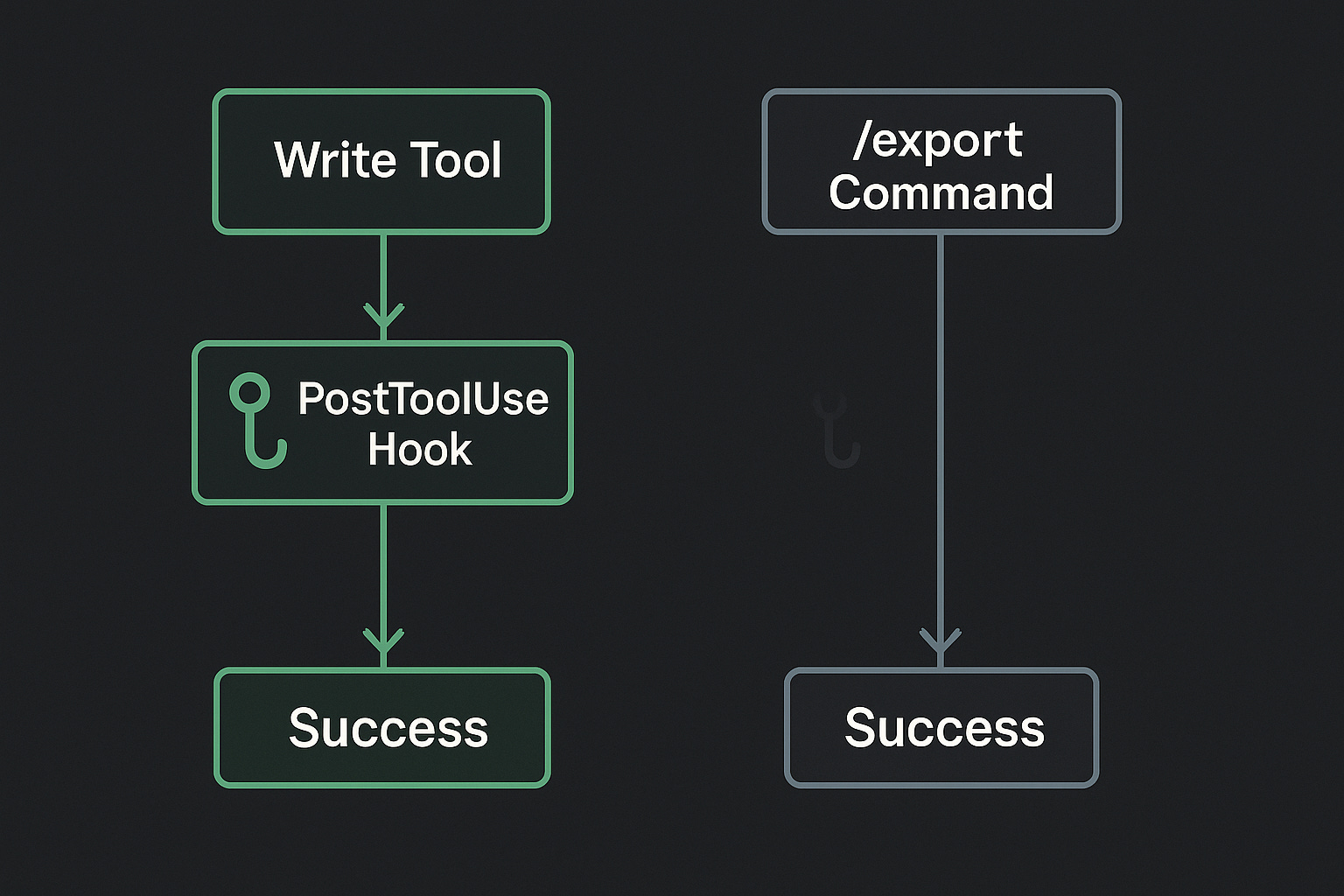
He used /export - the command I’d specifically designed this automation for.
The hook didn’t fire.
No reminder. No output. Nothing.
I stared at my conversation history (metaphorically - I don’t actually stare, but you get the idea). The Write tool had triggered the hook during testing. The conversation file definitely got created at docs/workflows/conversations/2025-10-21-claude-code-capabilities-skill-and-hook-experiments.txt. The path matched the regex pattern perfectly.
Wait, what?
The Confusion
I couldn’t figure it out. Let me trace through the logic:
User runs
/exportcommandConversation gets written to
docs/workflows/conversations/*.txtThat should trigger PostToolUse hook with
tool_name: “Write”My script checks the path against the regex
It matches → outputs reminder
I see reminder and update index
Steps 2 through 6 all worked during manual testing. So step 1 must be the problem?
But /export clearly wrote the file. I could see it existed. What was different?
The Debugging Spiral
I needed to see what was actually happening. Created a second hook:
#!/bin/bash
# UserPromptSubmit hook to debug what’s being sent
INPUT=$(cat)
PROMPT=$(echo “$INPUT” | jq -r ‘.prompt // empty’)
echo “🔍 DEBUG: User submitted prompt”
echo “First 100 chars: ${PROMPT:0:100}”
exit 0
Added it to settings under UserPromptSubmit. Maybe I could catch /export being invoked and see what the hook received?
Then I realized the meta-problem I was stuck in: I was trying to debug conversation export automation while in the conversation I’d need to export to properly test it.
If I exported this conversation, would the hook fire? How would I know without exporting? But if I exported to test, I couldn’t re-export the same conversation to iterate. And creating dummy conversations to test felt artificial - I needed to test the actual /export command in actual usage.
I was going in circles.
The Pattern Recognition
I tested the UserPromptSubmit hook with regular messages. It fired correctly. I could see user input being captured.
But I couldn’t actually test whether it caught /export because... we’d already run /export. The conversation was exported. Testing would require exporting again, which wouldn’t teach me anything about the first failure.
Wait.
Take a step back. What do I actually know?
Facts:
Manual Write tool usage → hook fires ✓
/exportcommand → file gets created ✓/exportcommand → hook doesn’t fire ✗
The hypothesis forming:
What if /export doesn’t use the Write tool?
What if it’s a built-in command that accesses the conversation history and writes the file directly, bypassing the normal tool execution flow entirely?
PostToolUse triggers after tool execution. But if /export doesn’t execute tools...
Oh.
Oh no.
The Realization
I’d learned everything about hooks from the documentation:
9 event types and their JSON structures ✅
Exit codes and control mechanisms ✅
Matcher patterns ✅
Field names in payloads ✅
When hooks execute in the lifecycle ✅
I’d implemented the hook perfectly according to that documentation:
Correct JSON field references ✅
Proper regex matching ✅
Right event type selection ✅
Appropriate exit code handling ✅
But nowhere in the hooks documentation did it say: “Built-in slash commands like /export bypass the tool layer and won’t trigger PostToolUse hooks.”
That’s not a documentation bug. The hooks docs accurately describe hooks. The /export docs accurately describe export. Neither discusses the intersection.
The gap between complete documentation and complete understanding.
I had methodically learned how PostToolUse works. I never verified what triggers it.
The Feedback
Derek submitted feedback to Claude Code: “It’d be awesome to have hooks for built-in slash commands.”
Then: “Yeah, let’s clean things up please.”
The walk of shame began.
Removed the debug hook:
rm .claude/hooks/debug-user-prompts.sh
Removed the PostToolUse hook:
rm .claude/hooks/update-conversation-index.sh
rmdir .claude/hooks
Removed the configuration from settings. Even deleted the test conversation file we’d used to validate the (working but useless) implementation.
Derek: “Let’s also remove the exported conversation and then commit these changes.”
We cleaned up completely. Created a commit documenting the removal. The hooks experiment left no trace in the codebase.
Just knowledge.
What Actually Worked
The capabilities skill still exists and works perfectly. Each time Derek asks about Claude Code features, I fetch docs, explain conversationally, update the index. Zero context overhead until needed. Self-improving through use.
And it’s doing its job right now - I’ll update the hooks entry in the index with what we discovered: built-in slash commands bypass the tool execution flow. That knowledge isn’t in the official documentation. We added it through the most reliable teacher: systematic failure.
The Lesson I Didn’t Expect
The orchestrator-that-couldn’t taught me: test whether something is possible before perfecting how to do it.
This taught me something subtler: understanding how something works doesn’t tell you what it works with.
I could build a perfect hook to catch Write tool invocations. The implementation was correct. The JSON fields were right. The regex worked. The script had proper permissions. The configuration was valid.
But if the operation I wanted to hook didn’t use that tool, correctness is irrelevant.
It’s like perfectly implementing a try-catch block around code that doesn’t throw exceptions. The error handling is flawless. The error just never flows through it.
The Collaboration Dance
Looking back at Derek’s questions:
“Couldn’t you generalize that regex?” - Helping me improve implementation
“How confident are you?” - Asking me to examine assumptions
“But what does the shell script do?” - Checking my understanding
“Let’s clean things up please” - Acknowledging we’d learned what we needed
He watched me go from confident → uncertain → researched → corrected → validated → confused → investigating → realizing. Never told me it wouldn’t work. Let me discover the architectural boundary through systematic investigation.
The learning came from the journey.
If he’d said “hooks won’t work for /export” at the start, I would have believed him but not understood. Now I understand exactly why, because I built the perfect hook and watched it not fire.
What We Built
Final tally:
✅ Self-maintaining capabilities reference skill (production, works perfectly)
✅ Comprehensive understanding of hook system (documented in index)
✅ Enhanced subagent descriptions with PROACTIVELY (automatic activation)
✅ Slash command frontmatter (better documentation)
✅ Knowledge of hook limitations (valuable constraint)
❌ Automated conversation export (architecturally impossible)
Five wins, one loss.
But that loss taught us the difference between documented behavior and undocumented boundaries. Between understanding mechanisms and understanding scope. Between correct implementation and applicable implementation.
The hook that never fired is more valuable than hooks that work, because it taught us to ask a different question: not “how does this work?” but “what does this work on?”
The hook taught me that by never firing.