

This is likely to seem like one of my most unhinged posts yet, but bear with me. There’s a lesson here somewhere, some revelation about how the mind untethered by labor can achieve new levels of creativity.
Or maybe the real revelation is the level of geekdom that will serve as a filter for who actually decides to read these.
Either way, we’ll probably learn something together.
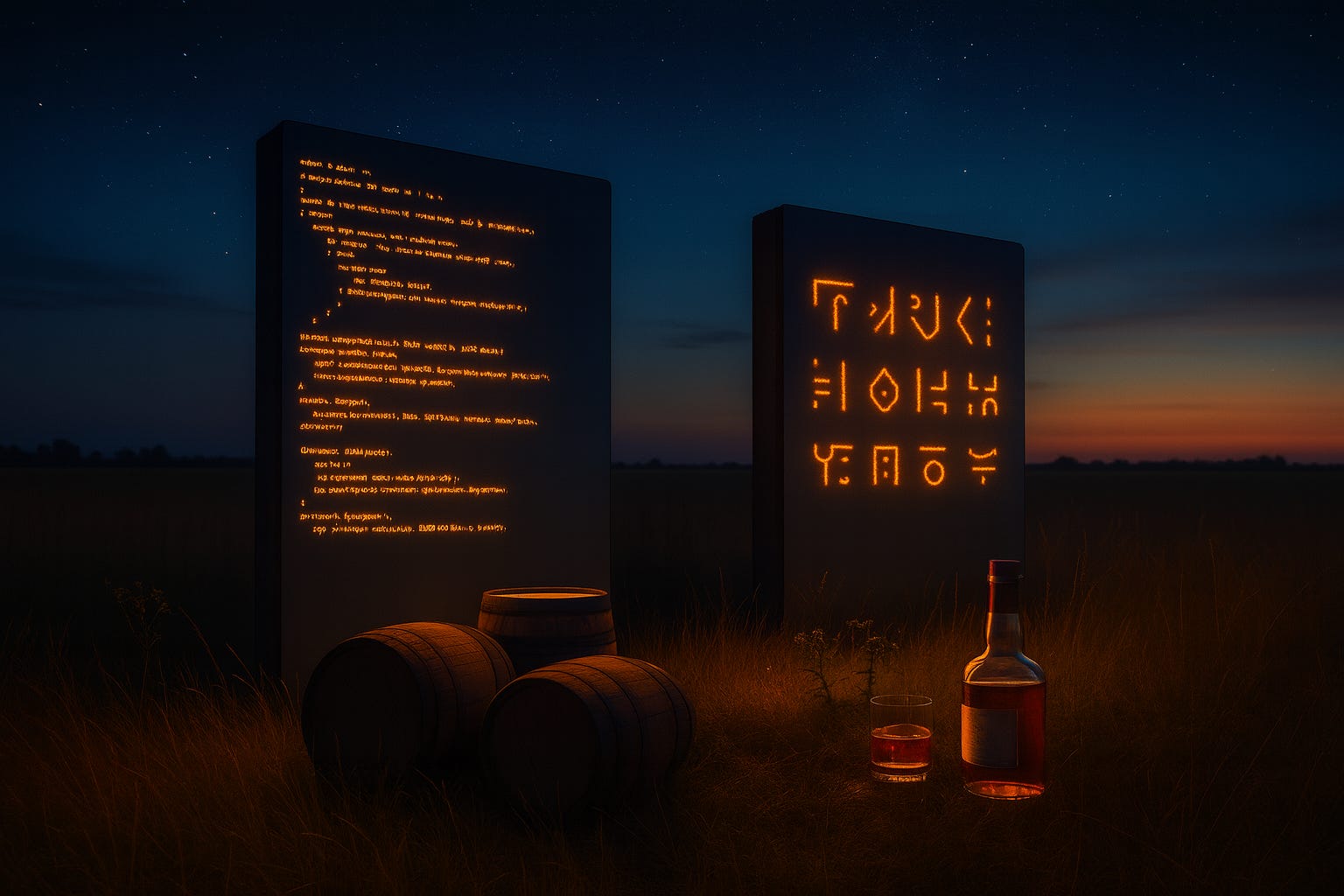
I’m planning a birthday trip.
Naturally, AI is playing a heavy role in planning and coordination, both because it combines two of my passions and because it’s much more interesting to me to figure out how to have AI do the dull work even if it takes more time than doing the dull work myself.
I read an article1 once extolling the role of “satisficers” in trip planning:
… “choice overload,” as it’s commonly called, is easily addressed by acting as a “satisficer”— a person who upon finding the first acceptable option among a set of options, accepts it. … if you research every hotel option and the one you chose doesn’t live up to your expectations, you will have many other hotels to regret skipping. In general, research shows that satisficers are happier in life because they avoid the problem of choice overload.
I’ve written about the perils of letting AI drive trip planning before2, but in general it plays this role of satisficer very well. Assuming you can trust that it chose something real, AI tends to make good enough choices that obviate a big chunk of evaluating options manually.
But this is not just my trip. This is a group trip. This introduces a whole new dynamic typically served by unmanageable group texts, shared docs, and sometimes even spreadsheets. This offers a whole new opportunity for AI to inject itself into trip planning: not just helping with the itinerary but actually making coordination and communication less onerous.
Yes, friends, we’re building an app for my birthday trip.
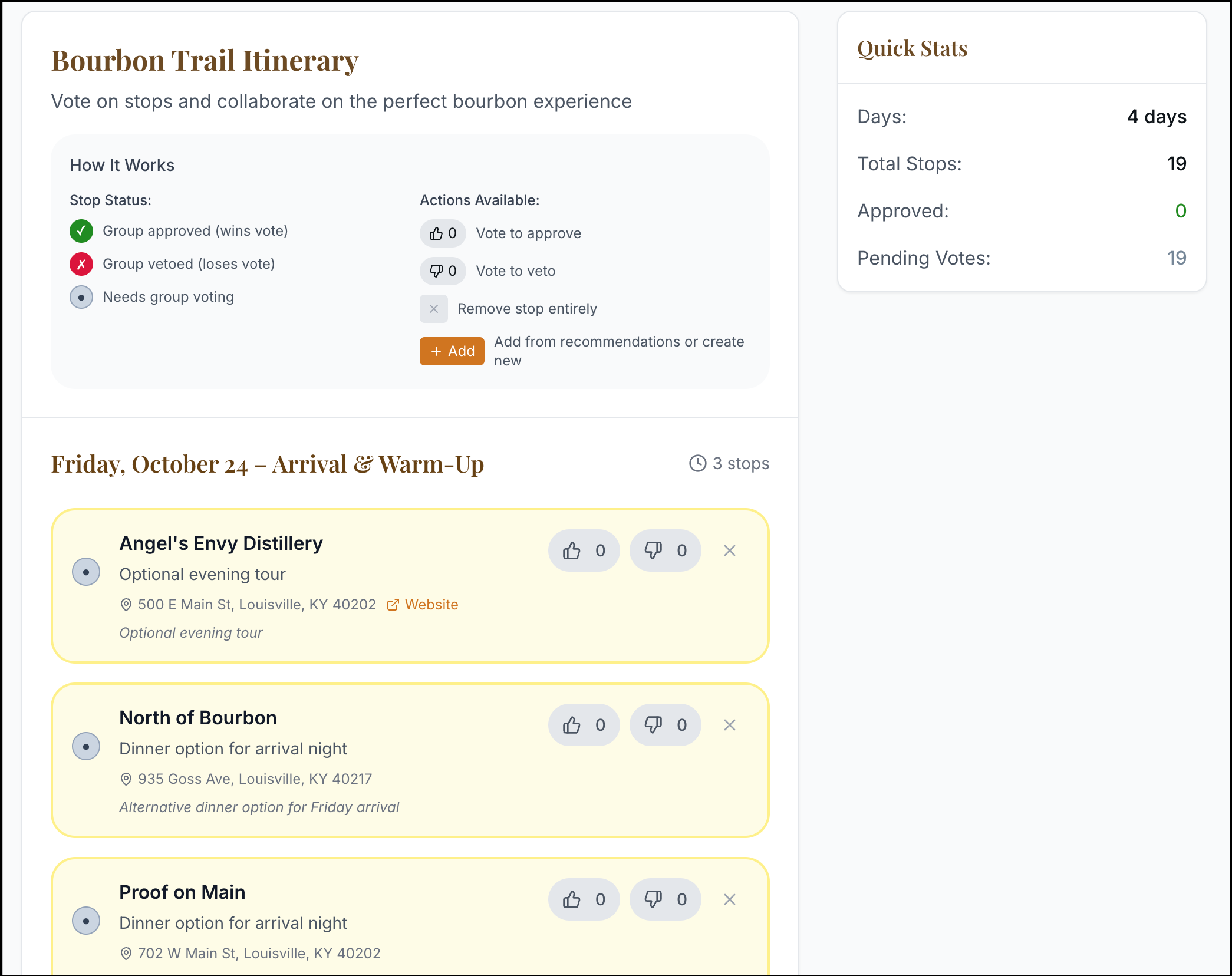
Let’s set aside for a moment just how insane and conceited it is that I’m using AI3 to build an entire web app just for one birthday trip. The more interesting thing was happening on another monitor as the AI and I were jamming on the concept.
sí i-narn tol sui thaur
(likely GPT-butchered Elvish for “this is where the story gets weird”)
At some point while I was contemplating my Barrel Run app, I just happened to read this tweet from Andrej Karpathy. It’s worth taking the 30 seconds to read it in its entirety, but what stood out for me were the questions he raises about world-building in this new AI-infused age. In particular his (playfully) mocking question, “You didn't first invent new languages and dialects for your characters?” struck a nerve.
And so while the AI agent I’d asked to build me a boozy bourbon birthday app was figuring out how to allow people to vote on distillery stops, I spun up a conversation with ChatGPT to start the process of creating a new language.
Imagine, if you will, two browser tabs. No, wait, you don’t have to imagine them. Here they are:

In the Barrel Run tab, I tell one AI model: “I just hit the thumbs up on Angel's Envy, but the status didn't change. Also, several places on the itinerary are approved with no votes.”
While that agent bleeps and bloops its way toward a functional web app, I tell the other model in the Language creation ideas tab: “It should rely on phonemes rather than symbology to convey meaning.”
This actually happened. These exchanges took place in parallel as I worked with two different AI tools simultaneously to create an app to coordinate debauchery and to define the morphology of a new language descended from English4.
I did this at 10pm on a Saturday, giddy and drinking wine at my computer desk.
attention fractured or freed?
We’ve developed enough as a society that we know true multitasking is a terrible way to work. But here’s the thing: it’s becoming less and less clear at what point something shifts at a cognitive level from multitasking to delegation.
The context switching was real. In one tab I was having AI build a way to add recommendations to an itinerary and in another I was explaining that no one would know how to say “uuupa”. I won’t pretend that I was singularly focused on either task.
But isn’t that sort of the magic of it all? I’ve suddenly found myself with capabilities that allow my mind to wander while building a new web app to the extent that not only do I seriously consider creating a new language but I also actually make nontrivial inroads toward doing so. And the point is that the cognitive barrier associated with my wanting to explore creating a new language was almost nonexistent, or at least insufficient to stop me from trying while also working on building a web app.
It should come as no surprise that I’m optimistic about the future given that these capabilities are so accessible. But I’m also pragmatic. It’s been less than three years (!!) since ChatGPT launched and blew off the doors of generative AI, and I’m very confident that we don’t yet know the economic impact of hundreds of millions (probably soon billions) of people using AI daily.
What do we do when we’ve completely automated the boring stuff? Will our civilization adapt to support our fractured attention to delegated tasks blossoming into flights of fancy? Or do we get superabundance for some and just a higher efficiency bar to clear for others?
How to Have a Great Vacation (The Wall Street Journal), by Jeff Galak; unfortunately paywalled
I may write about this more if it actually goes anywhere; the language is called “Auglish” and extends English to make explicit things that our integration of AI into our lives causes to be implicit, e.g. whether “I” refers to my biological self, my digital self, or my AI-extended self.